
Political Economy of Industrial Policy in Türkiye: Strategic Blueprints and Institutional Bottlenecks
It is hard to find many policies whose trajectories have shifted as dramatically as industrial policy. Since 1945, it has reached a peak, then fallen out of favour, and subsequently made a strong recovery. With the rise of free-market economics in the 1980s, industrial policy became a byword for corruption, rent-seeking, and inefficiency. Academics denounced it, suggesting “the best industrial policy is none at all.”[1] Media commentators discredited it, arguing “governments that bet good money on their favourite industries usually lose their shirts.”[2] And policymakers dismissed it, claiming “government is not the solution to our problem; government is the problem.”[3]
Yet industrial policy reemerged after the 2008 Global Financial Crisis. The COVID-19 pandemic accelerated this trend, as governments took a more central role in safeguarding supply chains, addressing cost-of-living challenges, tackling food and energy crises, and supporting the green transition. Additionally, industrial policy often has a geopolitical aspect, as it is closely tied to national security concerns. The rise of China as a hegemonic contender and the growing great power rivalry prompted American policymakers to pursue more active industrial policies. The Biden administration’s CHIPS and Science Act and Inflation Reduction Act are clear examples of active industrial policy. The European Union adopted a set of industrial policies to secure its place in the global economy. China has long implemented state capitalism with an active industrial policy component, and all other major economies have now adopted a more interventionist economic policy, reversing the fortunes of neoliberal globalisation in the early 21st century.
Türkiye is one of several countries attempting to adapt to this new trend, with varying degrees of success.[4] Multiple contradictions characterise the contemporary Turkish political economy. Since 2020, Türkiye has had to contend with the COVID-19 pandemic, a devastating earthquake in southern Anatolia, two highly contested elections, and domestic political instability—all combined with a regional context of ongoing wars in the Black Sea and Middle East. The country has also faced its highest level of inflation since the 1990s. At the same time, Türkiye’s first unicorns (privately held startup companies) emerged in 2021, the automotive industry achieved record exports in the past few years, and advancements have been made in indigenous defence technologies. Despite these achievements, the Turkish economy continues to face structural challenges, marked by a decade of declining investment and productivity growth, persistent external trade deficits, and high inflation in recent years.
Since 2010, Türkiye has adopted an active industrial policy to address these challenges. The initial industrial strategy framework aimed to reduce Türkiye’s import dependence in critical domains, reaffirming the importance of the manufacturing industry. This was followed by measures for a tech upgrade, culminating in the 2019 Tech-Driven Industry Initiative, which was further developed in 2021 to include a Green Agenda and a National Artificial Intelligence Strategy. In early 2025, an increased focus on innovation was accompanied by the 2030 Industry and Technology Strategy, supporting the Ministry of Industry and Technology’s initiative, HIT-30 (High Tech Türkiye Investment Incentive Programme), announced in 2024.
Unlike the old industrial policies operating behind tariff barriers, the Turkish industry’s connections with global supply chains ensure the new policies remain mainly export-oriented, even though rising global protectionism makes export growth harder amid US-China tensions, and since 2025, the erratic tariff policies of the Trump administration in the United States.
However, the emerging international pragmatism regarding state intervention in the economy also offers opportunities for middle-income countries like Türkiye to implement high-tech-oriented industrial policies. Since 2010, Turkish industrial policies have begun to combat deindustrialisation, create thresholds for tech-led enterprises, and support breakthrough sectors, such as the indigenous electric vehicle (EV) and defence technologies. Turkish firms are active in various regions worldwide, with significant diversification in both products and markets through their exports.
There are two sides to Turkish industrial policy. As in many countries, strategic blueprints often face institutional bottlenecks, making effective implementation a challenge. In Türkiye, this has manifested as weakening institutions and rising macroeconomic instability caused by the centralisation, personalisation, and variability of policymaking. These conditions have diminished the transformative potential of industrial policies, which are already overshadowed by short-term, counter-cyclical, and electoral measures that reinforce rentier coalitions. As a result, the effect of policies on the overall productivity and technology adoption in broader Turkish manufacturing sectors has been limited, with some suggesting the Turkish economy is caught not only in a “middle-income trap” but also in a “middle-of-the-road-innovator-trap.”[5]
Blueprints: Tech-oriented, New Industrial Policy in Türkiye
In our book, Industrial Policy in Turkey: Rise, Retreat, and Return, we argue that the history of industrial policy in Türkiye is, at the same time, a story of missed opportunities. For example, in the 1970s, during the height of import-substituting industrialisation (ISI), which targeted domestic production behind high-tariff barriers, Türkiye successfully produced durable consumer goods. However, the country was late to transition to capital-intensive products and export-oriented industrialisation. Similarly, Turkish governments and corporations largely missed the global shift towards high-tech-oriented ICT (information and communication technologies) in the 1990s and early 2000s. Türkiye managed to establish regulatory institutions and stabilise its fiscal and financial situation following the devastating 2001 crisis, aligning with post-Washington Consensus policies. But the country did not pursue effective industrial strategies to develop globally competitive companies in strategic sectors. Despite high growth rates in the early 2000s, productivity in the manufacturing sector was not robust, except in a few sectors, including white goods, motor vehicles, metals, and textiles.
After the 2008 Global Financial Crisis, the government finally began to show an interest in active industrial policies to address structural problems, with industrial policy seen as a viable option to reduce excessive reliance on imports, boost the country’s high-value-added production capacity, and mitigate exposure to fluctuations in international capital flows. Admitting that the past decade had seen low research and development (R&D) activities in Türkiye, the Minister of Industry and Trade promised change with a series of measures to incentivise R&D in private firms.[6] Accordingly, Law No. 5746, passed in 2008, provided incentives to the private sector to establish research and development (R&D) centres. The 2010 document, Industrial Strategy for Turkey 2011-2014, issued by the Ministry of Industry and Trade, provided an initial framework for industrial policy; however, it was not a transformative strategy aimed at cutting-edge technology, as seen in China’s “Made in China 2025” targets. It primarily reiterated the importance of the industrial sector to the Turkish economy. The policy instruments were primarily horizontal, targeting sectors where import dependence exceeded 50 percent, and projects had at least 40 percent domestic value added.
A shift towards a sector-based approach began with the “National Science, Technology and Innovation Strategy: 2011-2016.” The Strategy was supported by an incentives law in 2012, with an explicit emphasis on “strategic investments.” In 2016, the Supreme Council of Science and Technology (reporting to the Prime Minister) made additional decisions to develop a model for smart manufacturing, with R&D focused on pioneering digital technologies.[7] However, it was not until the 11th Development Plan (2019-2023) that a comprehensive high-tech focus became a central feature of policies aimed at tackling the productivity problem. The Plan set a clear target, aiming to increase the share of medium- and high-tech exports from 39 percent to 50 percent. Additionally, in 2019, a Tech-Driven Industry Initiative aimed to reduce Türkiye’s reliance on imports of intermediate goods, thereby reducing the current account deficit by $30 billion. Parallel to these high-tech-oriented strategic blueprints, gross R&D spending increased in the 2010s (Figure 1).
Figure 1. Gross research and development (R&D) spending, % of GDP
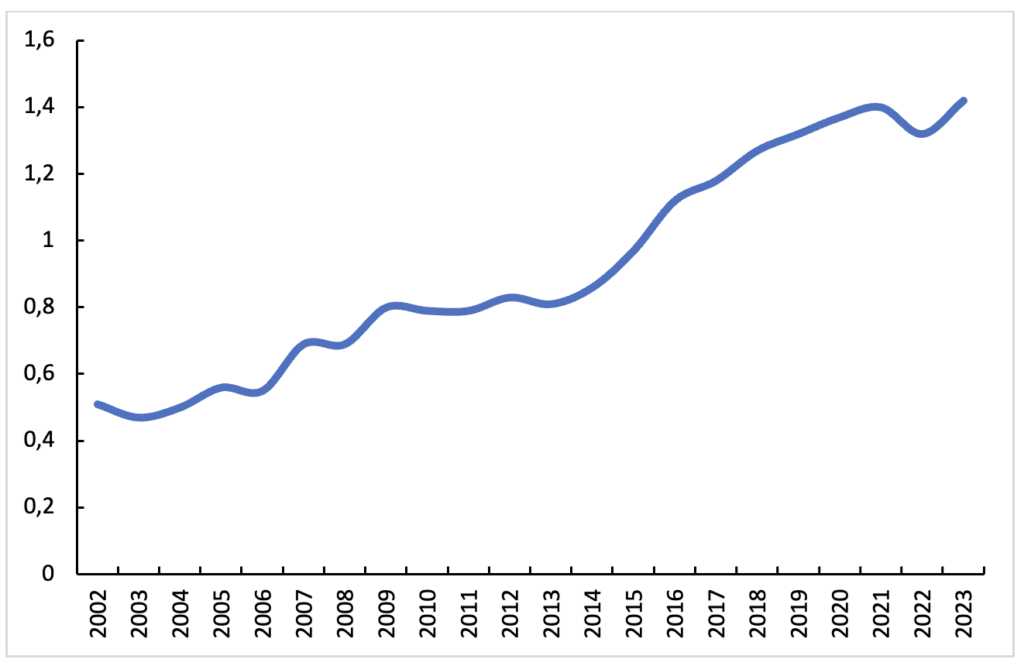
Source: TÜBİTAK and TÜİK
One tangible outcome of these initiatives is the indigenous automotive project, TOGG (Türkiye’nin Otomobili Girişim Grubu, or Türkiye’nin Otomobili Girişim Grubu). Echoing other well-defined, project-based industrial policies, a state-sponsored production of domestic EVs with lithium-ion batteries began producing models as scheduled in 2022. The project benefited from generous tax exemptions, investment site allocation, and public purchase guarantees. However, like other EV producers in Europe, the Turkish automotive sector faces challenges, including competition from much lower-priced Chinese imports and increasing regulatory barriers to exporting to the EU market.
Chinese investments in producing EVs in Türkiye also create additional challenges. In 2024, BYD, China’s premier EV producer, pledged $1 billion to produce EVs in Türkiye —the most significant inward foreign direct investment (FDI) in the Turkish automotive sector since the late 1990s— seeking to take advantage of Türkiye’s Customs Union agreement. Yet, the extensive incentives given to BYD (including tariff-free imports of 100,000 BYD EVs during the investment phase) are controversial, and concerns have been raised about the potential EU regulation on batteries sourced in China, which are part of the supply chain for EVs manufactured in Türkiye.[8]
In response to these challenges, auto producers have been taking several measures. Ford Otosan has led the EV initiative by producing electric commercial vehicles in Gölcük since 2022, making it a major hub for commercial EV production and export in Europe.[9] Zorlu Holding has entered the EV charging station business in a joint venture with Samsung. Some Turkish producers have begun to invest abroad, such as Ford Otosan’s $500 million investment to produce EVs in Romania. Other plans include expansion of the Renault/OYAK hybrid/EV production, with the hybrid engine to be “localised”, plans by Anadolu Isuzu to design and produce a light commercial truck named “Big-e”, and Tofaş’s establishment of an EV software R&D centre.[10]
As in many countries, the Turkish defence industry is a leading high-tech sector, incorporating the country’s few customised microchip production facilities into its supply chain. In 2021, the first domestically produced microprocessor, Çakıl, was unveiled, supported by the defence electronics firm Aselsan. In 2023, YITAL, a niche chip producer for the Turkish defence industry since 1983, began mass production of silicon-based chips with wider applications in industry at the Gebze campus of TÜBİTAK (Scientific and Technological Research Council of Türkiye). The campus, located in Kocaeli, is considered the Turkish technology hub and is close to the country’s rare earths deposits in Eskişehir. In 2024, defence and aerospace exports increased to $7.2 billion, up from $1.9 billion a decade earlier. Armed unmanned aerial vehicles (UAVs) constitute the most significant export item; however, Türkiye also exports armored vehicles and naval vessels. The sector is highly integrated into the EU defence industry, and discussions have begun on how it can be included in the EU defence fund. Long-term budget support, along with generous investment incentives, has helped raise the domestic content of defense manufacturing to around 70 percent, making it a leading export sector.[11] However, the diffusion of technology from defence to civilian manufacturing has proved more difficult and is one of the main priorities of the latest policy initiatives.
Then, there is Artificial Intelligence (AI). Governments and corporations worldwide have been rushing to utilise AI in recent years. Türkiye has also adopted a National Artificial Intelligence Strategy (2021-2025). The Presidency Science, Technology, and Innovation Policies Council (STIPC) identified priority areas, including 5G and beyond, AI, UAVs, nanotechnology, and others.[12] TÜBİTAK, the Ministry of Industry and Technology, and various specialised councils in the office of the Presidency, including STIPC and the Digital Information Office, are the key entities coordinating these policies. In addition, given the all-encompassing nature of AI technology, the services sector has become a major focus, involving ministries responsible for health, education, and transport and logistics. The services sector, which accounts for around 60 percent of GDP (2024 figures in current prices), has been growing rapidly, led by services exports, and is expected to be a primary beneficiary of increased productivity from AI applications.
These objectives are incorporated into the 12th Development Plan (2024-2028). The latest development plan was published in 2023, during a closely contested election and amid rising inflation rates of 60-70 percent, figures not seen since the 1990s. The Plan has been regarded mainly as an electoral exercise, with very long-term targets: 2053 is the year by which the Turkish economy is to achieve net zero in carbon emissions. At this point, assuming GDP growth in purchasing power parity (PPP) terms of five percent annually, the Turkish economy is expected to be among the top five economies in the world. Other targets include increasing the share of high-tech exports in total manufactured exports from around 3-4 percent to 5.5 percent by 2028 and to 17 percent by 2053. Although many previous governments have missed their development plan targets, these unrealistic figures appear to be setting new records. One widely announced but missed near-term target was to increase exports to $500 billion by 2023, the 100th anniversary of the Republic of China. The outcome was about half of that. This prompted public debate, with many arguing the target could not be achieved solely by increasing the volume of products sold abroad; the value added in higher-technology products also had to be boosted.
Consequently, the tech upgrade and decarbonisation of the economy have become central challenges for Türkiye, prompting the promulgation of the latest 2030 Industry and Technology Strategy to accompany the HIT-30 investment programme. The HIT-30 plan provides incentives that will last until 2030 to support four investment programs: digital transformation, green transformation, tech-focused industrial investments, and frontier industries. EV production, battery and chip technologies, and solar panel and wind turbine production are highlighted, supported by an additional ten R&D centers.
A Green Deal for Turkish Industry?
A notable aspect of the new industrial policies is their emphasis on green transformation. The EU, China, and other key stakeholders implementing industrial strategies aim to promote decarbonisation, but transitioning to an environmentally sustainable growth model presents significant challenges for developing countries, including Türkiye. In October 2021, Türkiye ratified the Paris Agreement. The government and entrepreneurs also face rapidly approaching targets to comply with the EU’s carbon regulations, such as the Carbon Border Adjustment Mechanism, which is especially relevant for sectors like cement, fertilizers, iron and steel, and aluminum. In July 2021, the Turkish Ministry of Trade extended existing industrial policies to better align with the EU Green Deal, endeavouring to maintain the competitive capacity of high-carbon sectors closely linked with European markets. In the same year, the government established the Ministry of Environment, Urbanisation and Climate Change and designed a national-level emission trading system to increase alignment with the EU Green Deal. In its latest initiative on climate change, the Turkish Parliament passed the long-debated Climate Law (İklim Yasası) in July 2025. Although lacking a roadmap for implementation and assessment, it provides the legislative framework for an emissions trading system, introduces new climate regulations, and establishes a Climate Change Commission.
The green agenda also matters for Türkiye because the country has traditionally sustained chronic current account deficits. Since energy accounts for a significant portion of the country’s import expenses, the green transition target ticks several boxes in facilitating the necessary structural transformation. In 2023, 42 percent of electricity was generated from clean sources (e.g., wind, solar, hydroelectric), placing Türkiye ahead of the global average.[13] Yet an assessment by the Technology Development Foundation of Türkiye (TTGV) rated policy measures on the greening of energy as relatively strong, but support for “sustainable industry and eliminating pollution” as weak.[14] It recommended more substantial incentives to industry to reduce carbon emissions, greater support for essential infrastructure for EVs, improved coordination, and a more “effective governance model.” These points were similar to those in the recent OECD Türkiye country report, including its proposal for “higher effective pricing of greenhouse gas emissions and transitioning away from coal,” to provide a more practical roadmap for achieving the net-zero target.[15]
Assessing the Effectiveness of Türkiye’s Industrial Strategy
How successful has Türkiye’s industrial strategy been since 2010? Despite the emergence of a few “pockets of efficiency” in the domestic EV sector (such as TOGG), indigenous defence vehicles (e.g., drones), and certain start-ups (e.g., gaming), Türkiye is far from replicating the success of East Asian developmental states, such as South Korea, or converging with other European economies. A recent UNESCO Science Report warns Türkiye faces the risk of being dragged into the previously mentioned “middle-of-the-road innovator trap.”[16] Türkiye’s innovation indicators are above the average of developing economies in general, but below those of OECD and EU economies.[17]
The European Innovation Scoreboard evaluates the research and development performance of EU member states and their neighbouring countries. The 2024 scores indicate that Türkiye’s overall innovation score lags significantly behind those of most EU members, including peer states such as Poland, Greece, Spain, or Portugal (see Figure 2). The challenge of maintaining a positive trend and promoting the diffusion of advanced technology across the broader manufacturing sector is evident in the stagnant share of high-tech exports in total manufacturing exports, which stood at 5 percent in 2024, falling short of the 5.8 percent target set by the 11th Development Plan. Türkiye’s share of high-tech exports, including computers, electronics, and optical goods, has remained stagnant at around 3-4 percent for a long time. Driven by defence industries and larger conglomerates, and benefiting from integration with EU supply chains, value added by the Turkish manufacturing sector has gradually shifted from low-tech to medium-tech production. However, after missing the early mover advantage since the 1980s —in sectors like semiconductors, which could have laid the groundwork for a broader transformation into a higher technology structure — a significant shift by Turkish manufacturing into high-tech production has yet to occur.
Figure 2. European Innovation Scoreboard, Summary Innovation Index
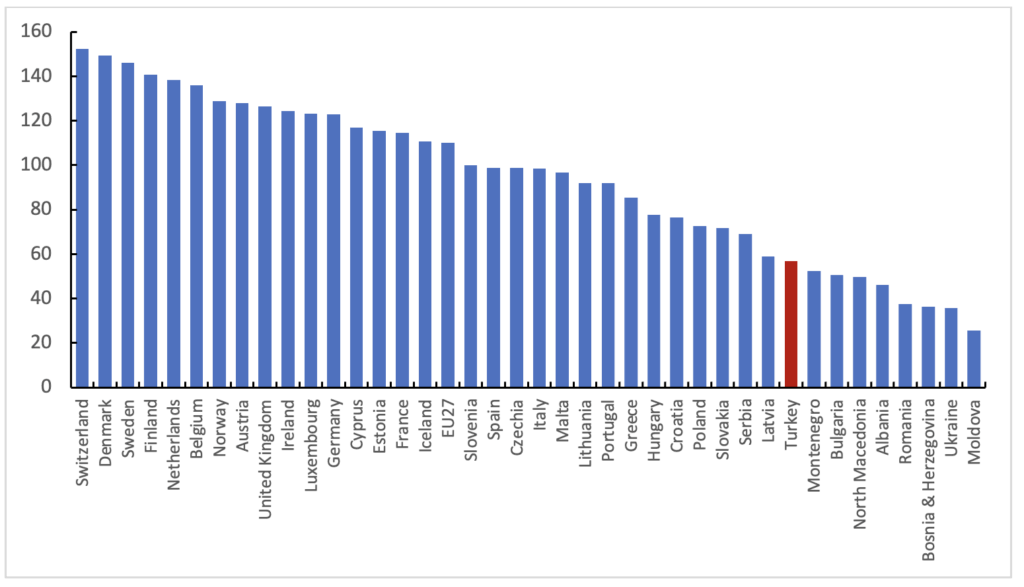
Source: European Innovation Scoreboard, 2024. Higher European Innovation Index scores refer to more innovative economies.
An Enduring Issue: Institutional Bottlenecks
No matter how well-designed blueprints and documents are, any industrial policy is only as good as its implementation. In the Turkish case, a set of institutional bottlenecks has hindered the effectiveness of industrial policies. Two challenges form fundamental constraints: funding problems and weak institutional capacity.
The funding of industrial policies in Türkiye has been generous, but not well-directed. The growing complexity of incentives makes monitoring and assessment difficult. The 2012 Incentives Law, complemented by a Super Incentive Scheme in 2016 and additional incentives for new technology projects in 2019, covered a wide range of state support for industrialisation projects in the form of tax exemptions, interest rate support, and land allocation. Responding to criticism of the vast array and complexity of past incentives, the latest HIT-30 investment plan has attempted to rationalise the incentive programmes. Of the four major components of the incentive policies (general incentives, priority sector incentives, strategic sector incentives, and regional incentives), the largest —general incentives— is proposed to be scrapped.
Since 2010, several industrial strategies have been adopted, although public investment as a proportion of total investment has declined. For example, the Türkiye Wealth Fund (TWF) has played an instrumental role in restoring state ownership of previously privatised enterprises, such as in the telecom sector. State banks have been heavily utilised to provide credit to private sector firms. Meanwhile, the role of private finance has remained limited, with institutionalized long-term capital market finance failing to become a major source of long-term investment, given its erratic availability and, in the context of macro-instability, its high cost. Equity financing remains low, and venture capital funding is among the lowest in Europe relative to the country’s GDP.
The productivity problems of the Turkish firms require a nuanced analysis. The limited diffusion of R&D from research institutions into the private sector is particularly challenging for small and medium-sized enterprises (SMEs), which comprise the bulk of industrial firms and account for 70 percent of the sector’s employment. SMEs supply a wide range of products, from furniture to those for the automotive and defence industries. This point is highlighted in a policy report on the automotive supplier industry, pointing out the challenge of technology adoption by SMEs in transitioning from combustion engines to EVs. The report notes that government-backed funding, such as tax incentives, has not been sufficiently effective in fostering innovation. It suggests that more skills training and better coordination with R&D centres are needed.[18] Insufficient R&D has trapped SMEs at the low end of the global value chains. In 2022, manufacturing value added by SMEs (factor cost) remained focused on low- and medium-low-technology sectors, accounting for 74 percent of total SME production, a slight decrease from 77.8 percent in 2009.[19] Despite various KOSGEB incentive programmes, access to long-term funding and export finance via TurkEximbank remains a significant problem for SMEs.[20]
A more fundamental challenge for the effective implementation of pro-development policies is the persistence and deepening of institutional problems. The political economy literature on development underlines the crucial point that the “sterile debates about ‘how much’ states intervene” miss the point.[21] As Evans points out, “The appropriate question is not ‘how much’ but ‘what kind.’”[22] At a time when geopolitical concerns, security of supply chains, and trade and technology wars dominate governments’ agendas, state intervention has become pronounced. States shape the market environment through tax incentives, customs tariffs, subsidies, and numerous other instruments. What distinguishes successful state intervention from others is a careful combination of “carrots” and “sticks” in shaping the preference functions of market actors. Governments provide incentives, or carrots, to encourage national corporations to invest in high-technology production. The Turkish state has designed comprehensive and generous incentive schemes since 2012. Türkiye’s signature industrial policy project, the domestic EV brand TOGG, is an illustrative example. Mordue and Sener estimate the “total value of the state package” to be around “US$3.5 billion” for this project, which “is very generous […] richer than any other automotive plant-level manufacturing incentive package ever proposed in Europe or North America.” [23]
It is not just carrots, however, that distinguish successful development-oriented industrial policies from less effective state interventions. “Sticks” are also important. State support and subsidies should be linked to carefully designed and mutually agreed-upon performance targets. In successful East Asian cases, states have not only provided macro-economic stability and supported private companies through lucrative subsidies but also established clear performance measurement criteria, withdrawing state support when recipient firms fail to meet preset targets. Maintaining a delicate balance between carrots and sticks is essential. In the Turkish case, the incentive schemes are not closely linked to clear performance criteria. They have functioned largely as counter-crisis support in the context of ongoing macroeconomic shocks. As a result, the technology-enhancing impact of those subsidies is likely to remain more modest than expected. For example, existing studies demonstrate that corporations use employment incentives to expand the utilisation of the low-wage labour force rather than to upgrade workers’ technological skills.[24]
The “new” industrial policies are more about governing state-market relations and establishing institutionalised deliberation mechanisms between the state bureaucracy and market actors. As industrial policy experts emphasise, it is not only about outcomes but also about the policy process:
“The right model for industrial policy is not that of an autonomous government applying Pigovian taxes or subsidies, but of strategic collaboration between the private sector and the government with the aim of uncovering where the most significant obstacles to restructuring lie and what type of interventions are most likely to remove them.”[25]
The effectiveness of industrial policies is determined by the institutional structures within which these policies are framed and executed.[26] This, in nature, is a political economy issue, not a technical optimisation problem. The institutional context of industrial policy in Türkiye is fragmented and fragile. This leads to high policy variance, with regulations, strategies, and targets changing frequently, making long-term policy implementation and impact assessment a challenging task. Given that effective industrial policies require patience and strategic pragmatism, commitment problems pose a fundamental challenge. Hence, as we conclude in the Industrial Policy in Turkey: Rise, Retreat, and Return, the effectiveness of the current industrial policies “primarily depends on how domestic institutional structures will evolve in the coming years.”[27] Since the book’s publication in 2023, with Türkiye’s institutional fabric further weakening, our conclusions on the challenge of establishing innovation ecosystems to raise productivity have become even more salient.
Industrial policy will remain a central issue for governments for the foreseeable future. At a time when infrastructures, flows, and resources can easily be weaponised amidst rising geopolitical tensions, industrial policy constitutes a crucial part of national economic statecraft. Additionally, systemically important economic challenges, such as climate breakdown, food and energy security, and widespread poverty and inequalities, require effective industrial policies. Türkiye has adopted an active industrial strategy in recent years, but its success and long-term outcomes depend on the institutional architecture upon which these policies are built.
References
[1] This phrase comes from Nobel Laureate economist Gary Becker. Quoted in Robert H. Wade, “Return of Industrial Policy?” International Review of Applied Economics, Vol. 26, No. 2, 2012, p. 223.
[2] Reginald Dale, “Governments Fail at Picking Winners,” The New York Times, 22 April 1994.
[3] Ronald Reagan, “Inaugural Address 1981,” 20 January 1981.
[4] This piece is based on and summarises some of the main points of our book on the evolution of industrialisation and development in Türkiye since 1923. See Mina Toksöz, Mustafa Kutlay, William Hale, Industrial Policy in Turkey: Rise, Retreat, Return (Edinburgh: Edinburgh University Press, 2023).
[5] UNESCO Science Report, “The Race against Time for Smarter Development,” The United Nations Educational, Scientific and Cultural Organization, 2021, p. 338.
[6] Interview with Nihat Ergin, “Turkey will become an R&D centre,” in Ekonomist, Special Supplement: Best of R&D, April 2011, pp. 8-12.
[7] Erkan Erdil and Şeyda Ertekin, “Industry 4.0 and Turkish National Innovation System: Challenges and Prospects,” ODTU/TEKPOL Working Paper 18/01, https://open.metu.edu.tr/handle/11511/83458
[8] Güven Sak, “BYD, Tayland’ı Sarstı, Sırada Türkiye Var”, Nasıl Bir Ekonomi Gazetesi, 19 August 2024. Also see, Sinan Ülgen, Can Selçuki, Alina İltutmuş, “Trade-Industrial Policy Nexus for Chinese Electric Vehicle Investments in Turkiye”, EDAM Report, August 2025.
[9] Vahap Munyar, “‘Koç, Ford gidiyor’ diyorlar, sadece otomotivde son 6 yılda 9.5 milyar dolar yatırdık,” Ekonomi Gazetesi, 30 June 2025.
[10] TÜSİAD/TÜBİSAD Raporu, “Türkiye’nin 2. Yüzyılında Yüksek Teknoloji için Eylem Çağrısı”, April 2023.
[11] Çağlar Kurç, “No Strings Attached: Understanding Turkey’s Arms Exports to Africa,” Journal of Balkan and Near Eastern Studies, Vol. 26, No. 3, 2024, pp. 378-395.
[12] STIP Compass: Turkiye Country Dashboard, https://stip.oecd.org/stip/interactive-dashboards/countries/Turkey
[13] Daily Sabah, “Türkiye outpaces world average as renewables provide 42% of power,” 8 May 2024.
[14] İbrahim Semih Akçomak et. al. “Greening Türkiye’s Economy: The Policy Perspective,” Technology Development Foundation of Turkiye (TTGV), 2023.
[15] OECD, OECD Economic Surveys: Türkiye 2025, (Paris: OECD Publishing), p. 9.
[16] UNESCO Science Report, p. 338.
[17] According to the IMF AI Preparedness Index (AIPI), Turkey scores 0.54, higher than all emerging markets (0.46), but below advanced economies (0.68).
[18] PWC/TAYSAD, “Standing on the Verge of Momentous Change: Automotive Supplier Industry in Turkey,” January 2020.
[19] Data retrieved from the TÜİK database.
[20] Mustafa Kutlay and H. Emrah Karaoğuz, Development and Foreign Policy in Turkey: Rethinking Interconnectedness in a Multipolar World (London: Palgrave Macmillan, 2023), pp. 162-168.
[21] Peter Evans, Embedded Autonomy: States and Industrial Transformation (Princeton: Princeton University Press, 1995), p. 10.
[22] Ibid.
[23] Greig Mordue and Erman Sener, “Upgrading in the Automotive Periphery: Turkey’s Battery Electric Vehicle Maker Togg,” Development and Change, Vol. 53, No. 4, 2022, pp. 770, 774.
[24] Esra Durceylan Kaygusuz, İzak Atiyas, Beyza Polat, “Türkiye Sanayisinin Bugününe Bakış ve Öneriler,” TÜSİAD Raporu, Rapor no. TÜSİAD T/2023-6/633, 2023.
[25] Dani Rodrik, “Industrial Policy for the 21st Century,” September 2004, https://drodrik.scholar.harvard.edu/files/dani-rodrik/files/industrial-policy-twenty-first-century.pdf, p. 3.
[26] An OECD study on Latvia spells out seven government functions for an effective innovation ecosystem: OECD, The Public Governance of Anticipatory Innovation Ecosystems in Latvia (Paris: OECD Publishing 2023).
[27] Mina Toksöz, Mustafa Kutlay, William Hale, Industrial Policy in Turkey: Rise, Retreat, Return (Edinburgh: Edinburgh University Press, 2023), p. 236.
Authors


Mustafa Kutlay
Mustafa Kutlay is a senior lecturer in the Department of International Politics at City, University of London. His current research focuses on the comparative politics and political economy of developing countries (with particular reference to Turkey, Turkish politics and foreign policy), institutions and development in the global South, and political risk analysis. He is also a senior scholar at the Istanbul Policy Center (IPC).
You may also like
Energy Security and Green Transformation Amid Geopolitical Conflicts
Gökhan Bafra The world is undergoing a transformative shift in its energy systems. Although
Promoting Resilience and Prosperity in the Wider Black Sea Region and the Role of BSEC
The series of crises and disruptions the world has been through in the recent past, particularly the

Foreword
Aybars Arda Kılıçer Brazil, Russia, India, China, and South Africa, or the BRICS nations,

Post a comment